
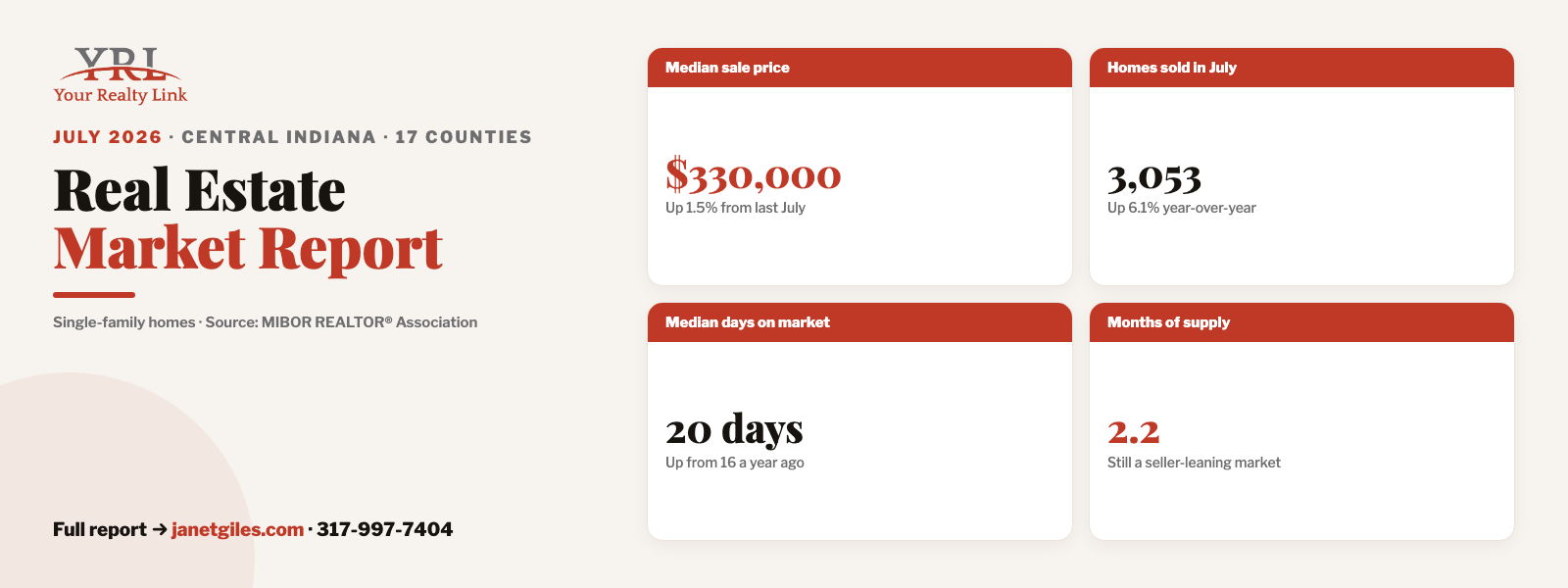
- Median sale price: $327,250 — up 2.6% from last August
- Closed sales: 2,738 — down 5.2% year-over-year
- Median days on market: 23 — up from 17 a year ago
- Months of supply: 2.5 — up from 2.1; still a seller-leaning market
- Active inventory: 6,941 homes — up 14% from a year ago
- Homes received 98.2% of list price on average
Here's the Indianapolis real estate market update for September 2026 — our read on where Central Indiana stands as we move through early fall, the calmer post-summer market. Instead of chasing one headline number, this focuses on what matters for your decision: whether it favors buyers or sellers right now, what's driving it, and what to do about it this month. For the latest official MIBOR figures on your specific area, our team is a call away.
The September 2026 Big Picture
Central Indiana remains one of the more balanced, affordable major metros in the Midwest, and September brings its own rhythm. The market settles into a steadier fall rhythm. Competition eases, and serious buyers aim to be settled before the holidays.
Conditions vary a lot by price point and location — entry-level and strong-school-district homes behave very differently from the luxury tier — so a metro-wide average rarely tells your street's story. That's where a local home valuation beats a headline.
This Month's Focus: Pricing & the appraisal gap
Correct pricing protects your deal — see what your home is worth. It's the theme we're watching most closely across Central Indiana this month, and it shapes the advice below for both buyers and sellers.
Where Prices Stand Across the Metro
Typical price ranges by county (ranges, not exact averages — your home's number depends on condition, updates, and exact location):
- Hamilton County (Carmel, Fishers, Westfield, Noblesville) — homes generally range from the $300s to well over $1M.
- Boone County (Zionsville, Whitestown, Lebanon) — homes generally range from the $250s to $1M+.
- Hendricks County (Avon, Brownsburg, Plainfield, Danville) — homes generally range from the $250s to the $450s.
- Johnson County (Greenwood, Franklin, Bargersville) — homes generally range from the $250s to the $450s.
- Hancock County (McCordsville, Greenfield, Fortville) — homes generally range from the $250s to the $500s.
- Marion County / Indianapolis — homes generally range from the $150s to the $500s and up.
- Outlying & rural communities — homes generally range from the $150s to the $300s.
Want the precise, current picture for your address? That's a quick, no-obligation comparative market analysis away.
What It Means for Buyers
Fewer competing buyers and motivated sellers make early fall a genuinely good time to buy — often with more negotiating room.
The fundamentals hold all year: get properly pre-approved, know your must-haves, and work with an agent who moves fast and negotiates hard. See buyer representation.
What It Means for Sellers
Fall buyers are focused. A move-in-ready, well-priced home still sells well; highlight comfort and a smooth path to a pre-holiday close.
Two decisions drive your result: pricing right from day one and presenting the home well. See pricing your home and home staging.
The Bottom Line
Through September 2026, Central Indiana keeps offering real value and steady demand relative to the coasts — a market where prepared buyers and realistically-priced sellers both have room to win. Act on your own timeline and your own numbers, not a national headline.
Curious what your home is worth, or what your budget buys today? We'll give you an honest, data-backed answer built on real, recent Central Indiana sales.
A market update is only useful if it helps you decide. Forget the national headlines — the number that matters is what your home is worth, and what your budget buys on your street, right now.
— Daniel Cope, Real Estate Broker, Your Realty LinkFrequently Asked Questions
Is it a buyer's or seller's market in Indianapolis in September 2026?
It depends on price point and location. Central Indiana stays relatively balanced and affordable, but entry-level and strong-school-district homes move faster than the luxury tier. A local comparative market analysis gives you the real answer.
Are home prices going up or down in Central Indiana?
The metro has seen steady, sustained demand thanks to affordability and job growth, varying by area and price tier. Look at recent comparable sales in your specific neighborhood — that's what determines value.
When is the best time to buy or sell in Indianapolis?
Spring brings the most listings and buyers; fall and winter bring less competition and more negotiating room. The best time is the one that fits your life — each season has real advantages.
How do I get current numbers for my neighborhood?
Contact Your Realty Link for a free comparative market analysis. We'll pull real, recent MIBOR sales for your exact area so you're working from today's numbers.
Get Your September 2026 Home Value
Skip the national headlines. Get a free, no-obligation home valuation built on real, recent Central Indiana sales — and know exactly where you stand.